
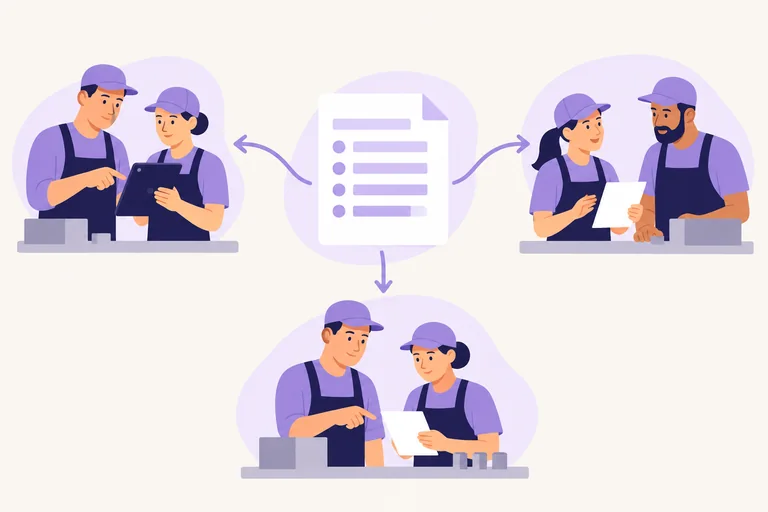
Roll out the changed work across every affected shift
Manufacturing SOP training should connect a controlled instruction with the people who will apply it on each shift. Sending the revised document is only one step. Operators, relief staff, maintenance and quality roles can encounter the change at different times and under different conditions. The handover needs to account for that variation.
The EU workplace safety framework addresses employer responsibilities for suitable instruction and training, including changes relevant to work and equipment [1]. Food manufacturing has additional requirements: Regulation (EC) No 852/2004 addresses supervision, instruction and training in hygiene suited to people's work, and appropriate HACCP training for relevant responsibilities [2]. These requirements should not be collapsed into one generic online course.
Tailor the rollout to the relevant task
The Commission's guidance on food safety management systems places training within the wider context of hygiene practices, HACCP and food safety culture [3]. The examples below are illustrative operational scenarios. They are not customer case studies and do not establish that every employee in every EU country needs an identical certificate, course duration or annual renewal.
Start by identifying the changed step and its consequence. A new cleaning sequence, inspection limit or restart approval can need different learning and practical checks. The process owner should decide what evidence is appropriate before the revised method enters use, giving shift leaders a clear basis for planning explanation and supervised practice.
Map roles, lines and substitutes
List the tasks affected by the revision. Include the people who perform them, verify them, support them and authorise exceptions. Use the current work pattern and substitution arrangements rather than relying solely on department membership. A maintenance technician may need a changed isolation sequence even if production owns the SOP. Include night shifts and less visible support roles. People covering breaks, weekend work or temporary absences can perform the same task with fewer colleagues available. Their training requirement should follow the duty, not their usual place on the organisation chart.
In an illustrative packaging scenario, the batch-code response changes. Operators need the detection and stop rule; quality staff need the evaluation and release criteria; warehouse workers need the identification of held pallets. The groups are connected, but their learning objectives differ. Targeted material can explain the shared interface while preserving role-specific decisions. Record the roster source and scope decision. If agency staff or contractors are involved, define who communicates the local instruction and verifies completion. Do not assume that general training supplied by another employer covers the plant's revised method. Equally, avoid assigning unrelated content just to make every row look identical.
Link readiness to the effective date
Agree when the new method becomes operational and what must happen beforehand. This can include equipment changes, removal of obsolete copies, learning activity and practical assessment. Training deadlines should support the release decision rather than trail behind it without an approved transition arrangement. Plan training time within the shift pattern. Many production workers have no individual computer. Browser access can help, but the organisation still needs a suitable device, understandable material and time. A course invitation cannot allocate those resources by itself.
Define the rule for absence, new starters and transfers. Someone returning after the release may need the revised instruction before independent work. A new starter can need initial instruction as well as the specific change explanation. Keep those needs distinct so the person receives enough context to apply the method. If readiness is incomplete, the owner should decide the consequence. Options depend on the task and applicable rules: supervised work, delayed release, reassignment or restriction can be relevant. Record the decision's scope and duration. An overdue list is useful evidence, but it is not an operational control until someone acts on it.
Teach the critical step and the abnormal condition
Build the material around actions employees must take. Explain the normal sequence, acceptance criteria, stop conditions and escalation route. Use pictures or examples where they clarify the actual task, but review them against the controlled instruction. A photograph showing an old setup can undermine an otherwise accurate explanation. Include the abnormal condition most likely to cause uncertainty. In an illustrative changeover exercise, the cleaning verification fails. The learner should know whether to repeat the process, isolate product, notify the responsible role or apply another approved response. A definition quiz about cleaning vocabulary does not test that decision.
For food handling, tailor instruction to the relevant hygiene task and responsibility. A line worker, a cleaning operator and the person maintaining HACCP procedures can need different depth and evidence under Regulation 852/2004 [2]. Avoid claiming that one completion certificate satisfies every food hygiene requirement. For safety-related tasks, check the required national and task-specific arrangements. An online SOP module can support communication and knowledge checks, but cannot automatically replace required practical instruction, supervision or authorisation. Language choice does not identify jurisdiction; an English-language guide is not inherently a statement of British or American workplace law.
Use the shift briefing without losing the individual trace
A supervisor briefing can provide context, answer questions and identify practical barriers. Prepare completion status beforehand so the briefing can give those questions the attention they need. It is especially useful where the revision affects coordination between roles. The briefing should follow the approved source, rather than introduce an unofficial shortcut based on local habit. Record the covered release, date, facilitator and relevant population. If the method includes an individual knowledge check, preserve those results separately. Attendance at a group session and an assessed individual result describe different events. Keep the record wording accurate.
Ask people to explain the changed decision in their own words or apply it to a scenario. A question such as "any questions?" can produce silence without establishing understanding. A concrete condition gives the supervisor something to evaluate and can expose ambiguities before the new method is used. Transfer unresolved questions to the accountable owner. If the source does not explain an equipment condition or conflicts with another instruction, do not make the briefing facilitator improvise an official rule. Record the issue and decide an interim control where needed. The final approved clarification should reach every affected shift. Check interfaces between roles explicitly. In a held-product scenario, the operator may identify the pallet correctly while the next shift assumes it is available because the transfer record is unclear. A learning exercise should include the handover, the label or status used and the role authorised to remove the hold. This is a proposed exercise, not a universal label specification. Its purpose is to test whether the connected steps form a usable process across the people involved.
Keep practical assessment distinct from course completion
For a changed setup, cleaning method or inspection technique, observe the task where appropriate. Define the critical steps, expected result and allowable assistance. The assessor should understand the process and record whether the person performed independently or needed prompting. An illustrative cleaning assessment can examine preparation, sequence, chemical handling under the approved method, verification and response to a failed check. The learning quiz may assess understanding of those steps, while observation assesses application. Neither should be represented as the other simply because both contribute to readiness.
Where task authorisation is required, record the authorised decision and its scope. A supervisor may grant permission only for a particular line or under specified conditions. A course completion record should not silently broaden that permission to other equipment or tasks. If performance is unsatisfactory, identify the reason and follow-up. The person may need practice, the instruction may be unclear or the equipment may prevent the intended action. Repeating an identical module does not repair a faulty process. Preserve the unsuccessful result and subsequent response so the history explains how the gap was managed.
Report by shift and task, not just overall completion
Show the required population, assignments, completion, results and unresolved actions for the relevant release. Include material and question-set versions where used. Make exclusions, report date and filters visible. A reader needs to know which people and activities the summary covers. Review the people scheduled for affected work. An illustrative completion rate of ninety-seven percent can hide the only untrained relief operator on tonight's line. The practical question is whether the scheduled work has appropriate capability and controls, not whether the plant average looks strong.
Give each unresolved item an owner so the shift leader knows whose support to arrange without repeating the same status requests across shifts. The next action may involve device access, explanation, practical assessment or a decision on supervision. Set a realistic date linked to planned work. A series of reminder notifications does not demonstrate that the issue was closed. Preserve the historical release. When the SOP changes again, the previous completion should remain linked to the instruction used at that time. This allows an incident review or audit sample to reconstruct what applied on a selected date. A current status alone cannot explain the sequence across several revisions.
Verify implementation after the release
Observe a proportionate sample of work after the effective date. Focus on the changed step, relevant exception and interfaces between shifts. Check whether obsolete instructions remain at equipment and whether local coaching still follows the old method. These conditions can defeat training even when every course is complete.
Review findings with the process owner. If the intended action is not being followed, determine whether the cause is learning, instruction quality, equipment, time pressure or conflicting expectations. Choose a response that addresses the cause. Do not assume another course is always the answer.
Keep a reviewable readiness chain
CrewShift can support procedure assignments, scores, completion history and exports, including browser-based learning. Create an account and evaluate the current workflow with one representative SOP rollout across your shifts. Check whether each leader can find the learning gaps before the briefing and use the time with operators to explain or demonstrate the changed step. Those records support the process; they do not independently establish practical competence, replace statutory safety instruction or guarantee food safety compliance.
The rollout is reviewable when the organisation can show what changed, who was affected, what learning and assessment occurred, which exceptions were controlled and what was observed after implementation. Keep that chain concise and accurate. The purpose is reliable work under the current instruction, with evidence that explains how readiness was achieved and helps leaders direct their attention to the people applying that instruction on the line.
Questions worth asking
Does every new SOP version require retraining everyone?
Not always. The response should follow the impact of the change. An editorial correction may need only a review record; a changed critical step may need full retraining and reassessment.
Can an employee complete the training on a phone?
CrewShift provides training through a phone browser. The organisation remains responsible for the conditions, device access and work-time arrangements under its rules and applicable law.
Can one course replace all food hygiene and safety instruction?
No. Tailor learning to duties and applicable requirements. Required practical, national or task-specific arrangements must be assessed separately.
Why review completion by shift?
An overall percentage can hide a gap among the people scheduled for affected work. The relevant decision concerns readiness for the planned task.
Sources and scope
- EU-OSHA — OSH Framework Directive 89/391/EEC
- Regulation (EC) No 852/2004 — hygiene of foodstuffs, Annex II, Chapter XII
- European Commission Notice 2022/C 355/01 — food safety management systems
- ISO 10015:2019 — official ISO page
This informational material does not replace licensed standards or individual legal advice.